Saving Organic Chemistry with Augmented Reality

CHALLENGE
Master’s thesis
WHAT I DID
Organic chemistry students
OUTCOME
EdTech
ROLE
TIMELINE
TEAM
DETAILED PROJECT BREAKDOWN
I designed and developed an AR app that improved student performance by up to 19% in stereochemistry
StereochemAR, a mobile AR learning tool I built as part of my Master’s thesis, helped chemistry students visualize complex 3D molecules from 2D diagrams. In a controlled study, students using the app scored up to 19% higher than peers using traditional models and showed statistically significant improvement on key spatial reasoning tasks (p = .036). This project demonstrated how immersive interaction design can unlock clarity in high-friction learning domains.

Students had a 63% average in organic chemistry and struggled with spatial visualization
Organic chemistry is one of the most failed science courses. From my own undergrad experience, I knew how painful stereochemistry could be. The core problem? Students had to interpret 2D diagrams as 3D structures, without tools that helped them think in three dimensions.
I created StereochemAR, a mobile app that turns static diagrams into interactive 3D models
I proposed, designed, and built an augmented reality app that allows students to scan stereochemical drawings and see them reconstructed in 3D. The app works on mobile phones and overlays the molecules into real space for exploration.
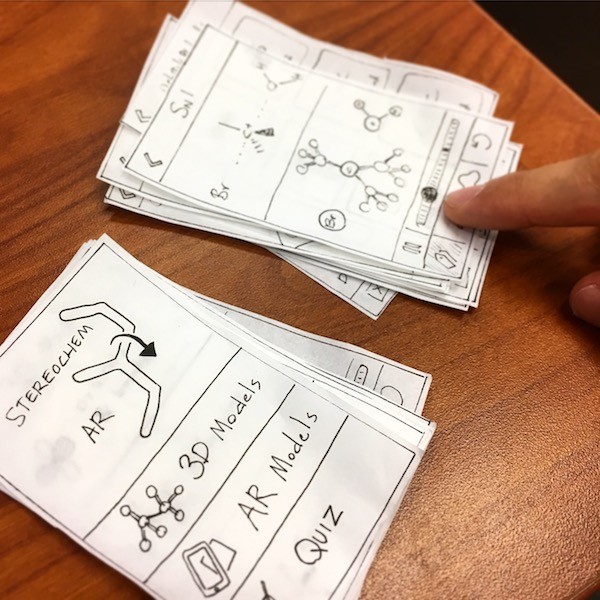
I validated the need and solution through interviews, testing, and paper prototypes
Before committing to development, I spoke with professors and students to understand their pain points. I created low-fidelity prototypes and tested them to ensure I was solving the right problem, and that I had a way to measure success.
I built the app in Unity, solving interaction and technical challenges through iteration
I worked solo on both design and development, tackling issues like molecular orientation, lighting, and device calibration. Through late-night debugging and ongoing user testing, I pushed through technical blockers to deliver a working, classroom-ready AR tool.

📈 Impact: Students using the AR app outperformed others across multiple measures
Students who used StereochemAR scored an average of 70.6% on a post-test—compared to 56.0% for a 3D app group and 51.7% for those using physical models. On key spatial reasoning questions (like drawing enantiomers), the AR group showed statistically significant improvement (p = .036). They also reported reduced frustration and faster understanding.
This project taught me how to lead a full product cycle, from idea validation and research through development and educational evaluation. I saw firsthand how well-crafted interactive tools can improve learning outcomes and reduce cognitive barriers in science education.