Transforming Antibody Search for Scientists

CHALLENGE
BenchSci’s antibody search matched raw text strings against biological data, not the vocabulary scientists actually search in. Six weeks before the company’s first global launch, beta users were telling us it didn’t work.
WHAT I DID
As BenchSci’s first and only designer, replaced fuzzy text-matching with a structured system built around scientific vocabulary, mapping targets, synonyms and biological entities the way scientists actually think about them. Shipped on schedule, six weeks out.
OUTCOME
Search stopped being the reason scientists doubted a result. The founders went from anxious in demos to confident, and BenchSci closed its first pharma deal with search as part of that story.
ROLE
BenchSci's first and only designer
TIMELINE
March-June 2017
TEAM
Founding team of scientists and engineers.
DETAILED PROJECT BREAKDOWN
Six weeks before a global launch, our beta users were telling us the product didn't work.
Not "the UI needs polish." Scientists couldn't find what they were looking for. The search felt imprecise, filters were buried, and beta feedback was consistent: the results weren't matching what researchers actually needed.
I was BenchSci's first and only designer. No process to inherit, no one to escalate to. Just me, a founding team of scientists and engineers who'd built something technically impressive, and six weeks.

Learning the system before redesigning it
Before I looked at the data, I assumed the problem was visual. Clearer filters, better layout, more intuitive interactions. I didn't anticipate how much the underlying data complexity would shape everything.
Sitting side-by-side with the founders to understand the system changed that quickly. Proteins mapped to synonyms, synonyms mapped to biological entities, entities mapped to antibodies. It took several conversations and a lot of sketching just to understand the relationships. The core problem wasn't the UI at all. The system matched raw text strings against biological data in ways that didn't reflect how scientists actually search. A researcher looking for an antibody isn't thinking in strings. They're thinking in targets, contexts, and applications.

The moment that mattered
Once I understood the data, the direction became clear: replace fuzzy text-matching with a structured tag-based system built around scientific vocabulary rather than keyword proximity. This also resonated with the founders — eliminating false positives made the search more trustworthy, not just more usable.
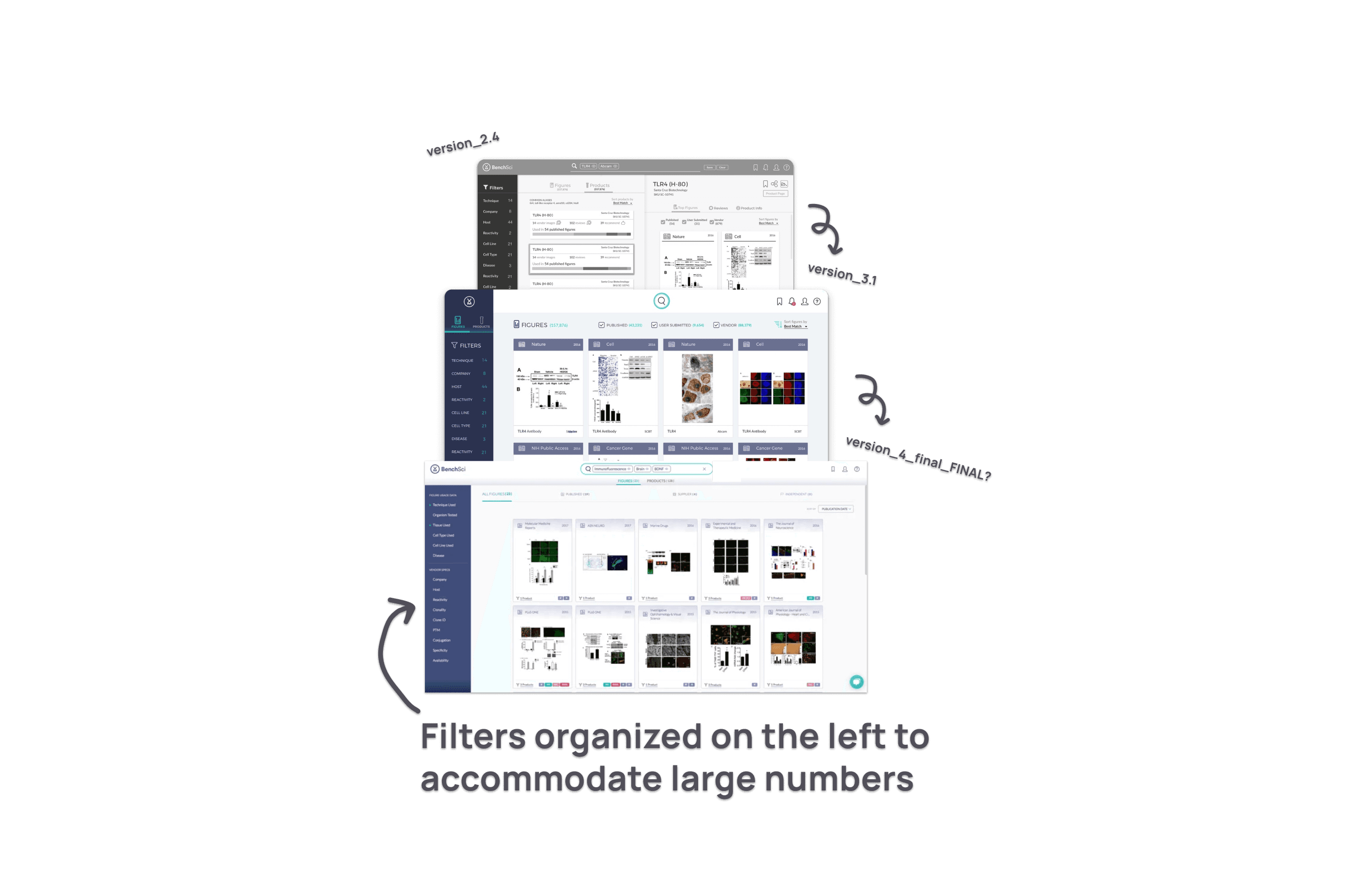
During prototyping, testing with mockups worked well. But I quickly hit a wall: it's nearly impossible to replicate real search behavior without real data. Static prototypes couldn't surface the edge cases that would matter most to scientists. I pushed to build a functional prototype using the actual data, which is where the most useful feedback came from.

What shipped
The redesigned search launched on schedule. Sentiment from scientists shifted noticeably: the problem was no longer incorrect results. The new challenge became expanding the number of results returned, which was a fundamentally different and more solvable problem.
The outcome I didn't anticipate: it changed how the founders felt in sales conversations. Before, there was real anxiety going into demos. A bad search result could derail the whole thing. After the redesign, results were consistently good enough that the founders could demo with confidence. The first pharma deal closed, and search was part of that story.

What I learned
We shipped without fully testing the functional prototype under real-world conditions, with the full breadth of data scientists would actually encounter. If I was to redo this project, that's the thing I'd do differently. Mockups can validate logic and layout. They can't tell you how a system behaves when there are thousands of possible results and a scientist is under pressure to find the right one.
The thing I still use from this project: sketch with the subject matter experts before touching the UI. Understanding the data relationships first changes everything about what you design.