Drove and shipped a 0→1 product to speed up drug target assessments

Overview
Challenge
To understand disease biology, scientists need to visualize relevant biological pathways. BenchSci’s platform lacked this capability, forcing scientists to leave the product and search external databases for pathway information. The fragmented workflow created friction and limited adoption. Despite its importance, no owner, project, or team was assigned to solve it.
What I Did
I defined the opportunity, tested early concepts with scientists, worked with engineering to create a proof of concept, shaped the strategy with commercial leadership, won buy-in from leadership, and assembled a cross-functional team. After doing user testing and iterations, we shipped the feature to our customers.
Outcome
We shipped the feature with a six-person team to Merck, Sanofi, and Amgen. Feedback from scientists was positive and it supported the enterprise sales cycle. Internally, it showcased to BenchSci's leadership what a small team could deliver and how design can lead projects.
Role
Principal Designer
Timeline
Apr – Sep 2024
Team
Started solo, scaled to 8-person team
Detailed Project Breakdown
Scientists had to leave the product to understand pathway context
BenchSci was building a new GenAI platform to help pharmaceutical scientists discover drug targets faster. A core part of it was missing. To understand how a drug target related to the broader biology, scientists had to leave the platform, open external databases, interpret pathway diagrams separately, and then return to continue their work.
That context-switching created friction in an important workflow and weakened the product’s positioning as an all-in-one tool for target discovery.

Research, strategy, and early prototypes won leadership buy-in and staffed the project
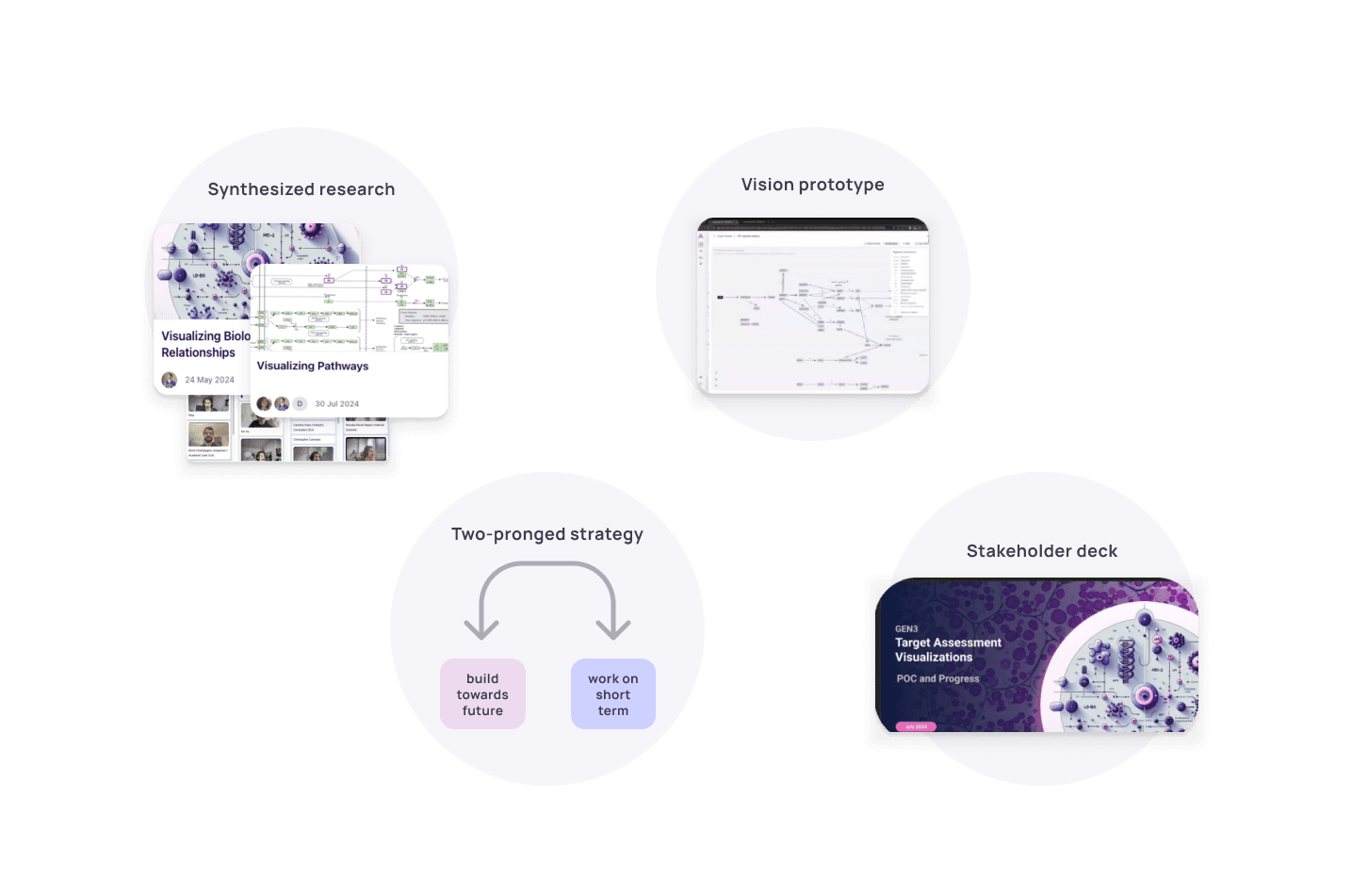
Before any engineers were assigned, I worked with a staff scientist to define the use cases, prototyped early concepts, and tested them with users.
In parallel, I shaped a two-part strategy with our SVP of Commercial Strategy:
Short term: integrate trusted external databases so users could access pathway context inside the product
Long term: move toward a more complete and accurate representation of biology across the platform
I packaged the user research, product strategy, and project proposal into a clear case for investment. That won support from the CPO, VP of Engineering, and VP of Science, and gave me the backing to form a small cross-functional team.
A restructuring cut the project to low priority, but the work was documented well enough to recover
The team started building. But then came a company reorganization. The project dropped to the lowest priority tier. Engineers had been reassigned. There was no formal mechanism to recover it.
I worked with the product manager to meet with engineering and product leadership and personally recruited contributors back. What kept the case alive was documentation: clear briefs, research artifacts, a validated vision. It gave the project legitimacy and made the path to approval straightforward. We got the resources back.

The team shipped the feature in four sprints and brought pathway context into the product
A team of six delivered pathway visualization directly inside the Target Assessment product. Scientists assessing a protein could now view relevant biological pathways from an external database within the platform instead of leaving the workflow to gather that information elsewhere.
The feature supported enterprise sales and showed that design can lead complex product work
Six people shipped it in four sprints. It went to production for Merck, Sanofi, and Amgen, and became part of enterprise sales cycles supporting seven-figure deals.
Internally, the project also changed how the work was seen. Our CPO cited it as proof that meaningful features could be built with a relatively small team. For leadership more broadly, it showed that design could lead a strategically important initiative from concept to launch.


Clear documentation is now a key part of my execution strategy
The synthesized research, lightweight briefs, and living prototypes reflected the team’s latest thinking. From the beginning, that documentation served to bring together my collaborators and stakeholders. It also helped the project survive the restructuring.
Since then, I’ve treated shareable strategy artifacts as a core part of execution, especially on projects that need stakeholder and cross-functional alignment to move forward.